Some things are too important to just chat about. — Nodalist, a visual reasoning workspace
Nodalist is a visual reasoning workspace for the thinking that matters most. Build your structure, map what connects, storm ideas through leading AI models, ground them with cited research, and shape the result into real work.
Free to use. No credit card required.
Build it first. Map it out. Storm it. Ground it. Shape it.
Big ideas require
structured thinking.
Watch how one thought becomes a complete action plan — powered by AI.
Click the arrow buttons to step through the demo.
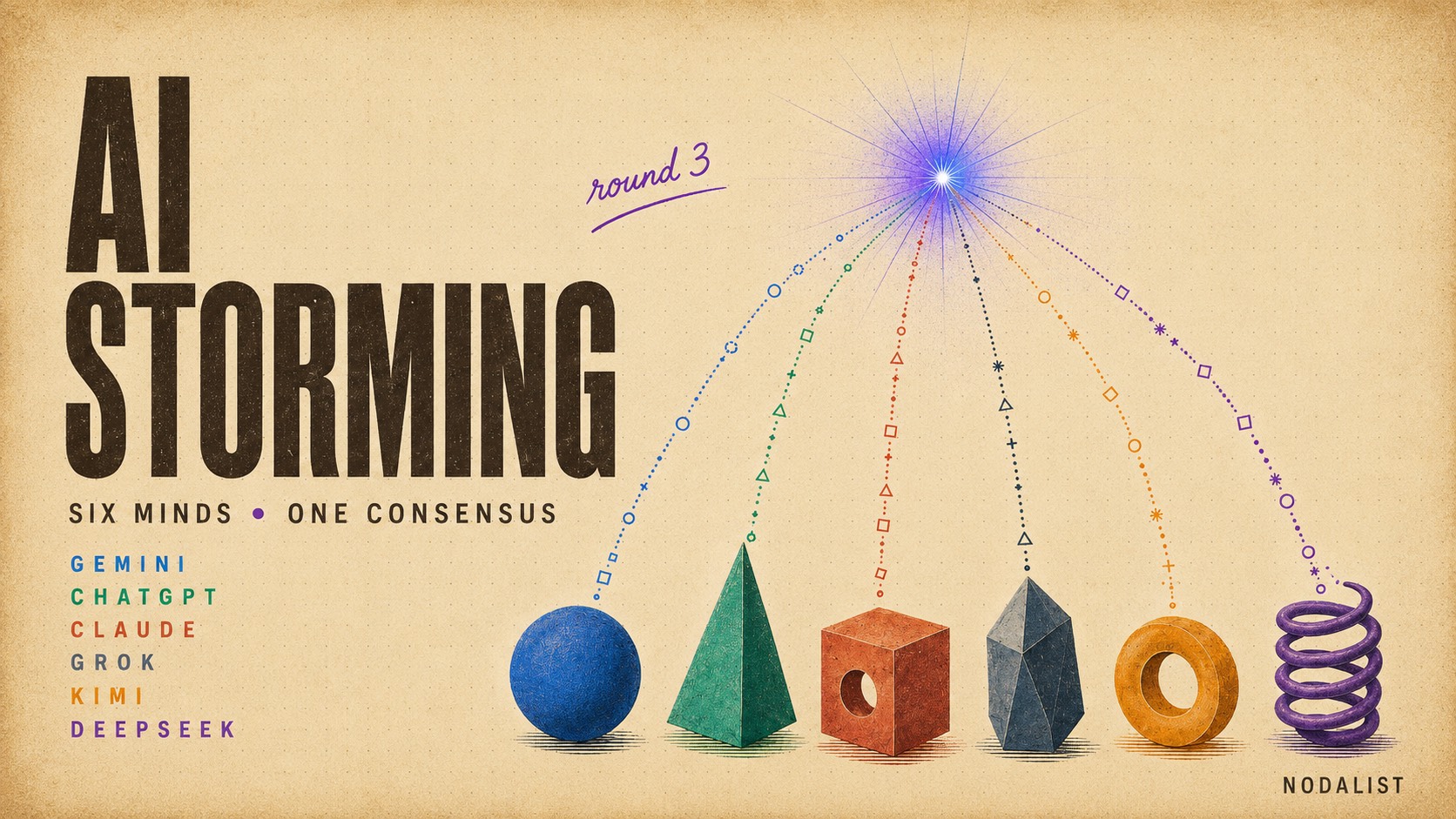
Six of the world's best, debating your specific problem, with your full context.
Your question. Your files. Your chain of thought. The most powerful AI models on the planet sit down in a room — with you.
They debate. They disagree. They build on each other.
One model sees a risk the others missed. Another proposes a solution no one considered. They challenge each other's assumptions in real time — and a moderator AI watches the entire discussion, tracking where they agree, where they clash, and what it all means.
Sit back and watch
Let them hash it out while you observe the most diverse, high-powered brainstorming session you've ever seen.
Or jump in
Steer the conversation. Push back on an idea. Ask them to go deeper. You're not an audience — you're the decision-maker in the room.
Structured final report
When it's done, you get the strongest ideas, the key disagreements, and actionable conclusions you can use immediately — sharper for having survived the debate.
Deep research that shows its work — every source, kept or discarded.
Ask a real question. Grounding turns it into a plan you approve, then works the open web topic by topic — searching, reranking, and checking its own coverage until it has enough to stand on, or it tells you the answer isn't out there. You watch the work happen on your canvas, and every call it makes is on the record.
You ask. It drafts a plan.
A question becomes distinct lines of inquiry — each one carrying the reason it's worth chasing. You read it before a single credit is spent.
You approve the scope.
Every topic carries its directive, a priority, and a credit estimate before anything runs. Edit it, drop what you don't need, then green-light it. Nothing runs until you do.
It iterates until the evidence holds.
Per topic it searches, reranks, and triages every source — then checks its own coverage. Gaps trigger fresh queries; it stops only when the evidence is solid or it genuinely can't be found. Pause and resume anytime; you're billed only for iterations that finish.
You get the answer — and the receipts.
A quality score across six axes, every source it weighed laid open to inspect, and a synthesized report when you want one.
Open the node. Three views.
Click any ResearchNode and it opens into a working surface — three views: the scorecards, the audit ledger, and the report. The evidence is always there to inspect; the report is optional. Here's what each one shows.
The scorecards.
Because the loop self-checks its own coverage, every topic earns a score on six axes — coverage, authority, recency, diversity, depth, focus. The shape of the spider tells you where the evidence is solid and where it's thin, before you read a word.
- One spider per topic. A notch on an axis is a real gap the model couldn't close — shown, not smoothed over.
- An overall quality score. A single number rolled up from every topic — a thin-evidence topic drags it down, and the number shows it.
- Backed by every source. The score isn't a vibe. It rolls up from the same sources you can open and weigh yourself in the ledger — none of them quietly pruned to flatter the number.
The audit ledger.
For every topic, you see what was kept and what was set aside — each with the reason behind the call. Nothing is dropped silently, and nothing is too inconvenient to show.
- The directive. Why this topic was worth the iterations in the first place.
- Kept sources. Relevance score, a real snippet, and the rationale for keeping it.
- Discarded sources. Same transparency — score, snippet, and a plain-language reason it didn't make the cut.
The synthesis.
When you want the narrative, Grounding writes one — sectioned, citable, and honest about its own limits. Every claim carries a marker back to the same numbered source in the ledger, so the prose never floats free of the evidence.
- Optional, never forced. The evidence stands on its own; the report is the value-add you choose.
- Inline citations. Each marker traces straight back to a source you can inspect.
- Says where the web is silent. It names the topics the open web couldn't answer, instead of writing past the gap.
Coverage is uneven across the topics where research succeeded. Datacenter PUE and time-matched renewable accounting are well-instrumented, with three independent sources agreeing within single-digit percentage points.[01·11]
Per-query energy is the opposite: a handful of single-model studies, one widely-cited estimator, and vendor disclosures that lack reproducible methodology.[05·06]
"When inference dominates lifetime emissions, training-day press releases obscure rather than disclose."
Research you can trust — because you can check every step.
Every conclusion traces back to a source it weighed in the open. Nothing hand-waved, nothing hidden, nothing it couldn't defend.
More on the method: agentic deep research · choosing an AI research tool
Bring your files too.
PDFs, documents, spreadsheets, images — drop them on the canvas and AI reads every word. Not summaries. Not guesses. Your actual content, powering every decision.
Drop it. Connect it. AI reads it.
Upload a file and connect it to any node on your canvas. AI doesn't just skim it — it reads the full content and weaves it into your thinking chain. Ask about a specific clause in a contract, a data point in a spreadsheet, or a finding in a research paper. AI answers with your document, not its training data.
OCR for scanned docs
Scanned PDFs, photos of whiteboards, handwritten notes — OCR extracts every word so AI can work with it. Even thousand-page documents.
Folder bundles
Group related files into folders, drop the whole bundle onto your canvas. AI searches across all files at once — like having a research assistant who's read everything.
Your context, not theirs
Every other AI tool loses your context between messages. Here, your files stay connected to your thinking graph. When AI generates a breakdown, makes a decision, or debates in Storming — it sees your documents, your branch history, and your decisions. That's context no chatbot can match.
Under the hood
A state-of-the-art
modified RAG system.
Most AI tools use basic vector search — embed your question, find similar chunks, hope for the best. Nodalist uses a three-tier retrieval architecture with an agentic search loop and cross-encoder reranking. Here's how it works.
Direct Inclusion
Full textSmall to medium files are included in their entirety — every word, every table, every footnote. No chunking, no retrieval loss. AI sees your complete document exactly as you wrote it, up to 80,000 characters. This is the gold standard: zero information loss.
Agentic RAG Search
AI-drivenFor larger files, a dedicated AI agent searches your documents intelligently. It doesn't just run one query — it runs an iterative loop: generating diverse search queries, searching the vector index, reranking results with a cross-encoder, evaluating whether the results are good enough, and refining its approach if they're not. Up to five iterations of self-improving search, across every file you've connected.
The agentic loop
Ancestor Cache
InheritedWhen you branch deeper into your thinking tree, descendant nodes inherit file context from their ancestors. No redundant searches, no wasted computation. The file knowledge compounds — every new idea automatically carries the research from every node above it.
Typical RAG
- Single query, single pass
- Raw cosine similarity ranking
- No self-evaluation of results
- Every query starts from scratch
Nodalist RAG
- Multi-query agentic iteration
- Cross-encoder reranking (BGE)
- AI evaluates its own retrieval quality
- Context cached and inherited across nodes
AI chats are genuinely powerful. They write code, analyze data, draft documents, explain anything. We use them every day.
But when the problem gets complex?
There's a structural limit.
Every detail matters. But as the conversation grows...
They compress without asking.
AI chats try to keep your context — but they hit limits. When they do, they silently decide what to keep and what to drop. Your specific constraints, the edge case from message 7, that number you mentioned once — gone. They don't ask what matters to you. They guess. And as the conversation grows, more of your thinking becomes someone else's summary.
Chat is linear. Reasoning is not.
Real thinking branches. You explore option A, realize it depends on B, circle back to reconsider C. But a chat is a straight line — you can't fork, you can't go back to a decision point and try a different path without losing everything after it. The medium forces your thinking into a shape it doesn't naturally take.
One model. One perspective. One voice.
No matter how good the model is, it's one opinion. It has blind spots, tendencies, preferences it doesn't disclose. For a code review or a draft, that's fine. For a decision that matters — market entry, hiring strategy, investment thesis — you need more than one angle. You need genuine disagreement.
AI chats are powerful tools. But complex thinking needs a different structure.
What if you built your own context?
Node by node. Branch by branch.
Build your thinking visually. Every idea is a node. Every alternative is a branch. See the full picture — no scrolling back through pages of text. Go back to any decision and explore a different path without losing anything.
Your files. Any size. Even scanned.
Upload PDFs, spreadsheets, research papers. Got a 1,000-page scanned contract? OCR handles it. AI searches your documents and weaves relevant passages into your thinking — automatically.
AI that reads your entire chain.
When you ask AI for help, it reads everything — every parent node, every branch, every decision, every file. Not generic advice. Thinking that actually fits your specific situation.
Still stuck? Six AI models debate it.
Gemini, ChatGPT, Claude, Grok, DeepSeek, Kimi — each thinking differently about YOUR problem, with YOUR full context. They argue, challenge each other, and deliver a structured report. Not one opinion. Six.
Everything you need to think through anything.
Are you a Nodalist too?
Bring your hardest questions. Your canvas, your nodes, and AI will do the rest.
Free to start. No credit card required.
What is Nodalist AI?
Nodalist is a visual reasoning workspace where you build your ideas as connected nodes — then let AI expand them. You can break down complex problems into structured branches, make decisions with AI-generated options, upload your own files (PDFs, documents, spreadsheets, images) so AI reasons with your actual data, and bring six top AI models into a live debate room to argue your hardest questions. Everything stays connected: your files, your decisions, your reasoning chain — nothing gets lost between messages.
What is a visual reasoning workspace?
A visual reasoning workspace is a place where complex thinking takes shape visually instead of inside a linear chat thread. The core insight: chat is linear, reasoning is not. In a visual reasoning workspace, ideas are mapped as connected nodes so relationships and gaps become visible, challenged before they become final work (in Nodalist, through AI Storming — a moderated debate between leading AI models), grounded with context, files, and cited research, and then shaped into real outputs — documents, visuals, and exports. Nodalist defined the category: it keeps AI useful, but puts the structure, direction, and reasoning back in your hands.
How is Nodalist different from AI chats?
AI chats try to keep your context, but they have limits — so they silently compress it, deciding what matters and what doesn't without asking you. The longer the conversation, the more your context degrades into noise. Nodalist flips this. You build the context yourself on a visual canvas — only what matters, structured the way you think. Every node carries the full history of its branch: parent ideas, resolved decisions, file content, prior AI outputs. You control every breakpoint. When AI generates from a node, it sees exactly what you chose to include — not a compressed summary of a 50-message chat thread.
Who should use Nodalist?
Anyone who thinks through complex problems — strategists, researchers, analysts, founders, product managers, consultants, students tackling a thesis. If you've ever had a question too big for a single AI prompt, or wished you could show AI your actual documents and branch into multiple directions at once, Nodalist is built for you.
What can AI do on the canvas?
Three core modes: Breakdown splits a topic into structured sub-nodes, Decision generates options and asks clarifying questions before committing, and Generative creates open-ended expansions. Connect files to any node and AI reads them — small files in full, large files through intelligent search. Then there's AI Storming: six models (Gemini, ChatGPT, Claude, Grok, DeepSeek, Kimi) debate your topic in real time, challenge each other, and produce a structured consensus report.
How do files work?
Upload PDFs, DOCX, XLSX, images, or text files. Small files are included directly — AI sees every word. Large files are indexed and searched with an agentic RAG system that iteratively refines its queries, reranks with a cross-encoder, and evaluates its own results. You can also drop entire folders onto the canvas for multi-file analysis. OCR handles scanned documents and handwritten notes, even thousand-page PDFs.
Do I need to pay to start?
No. Nodalist is free to start with 250 monthly credits. You can build on the canvas, generate AI branches, and try AI Storming right away. Paid plans start at $5.99/month and unlock file uploads, more credits, OCR, and storage up to 15 GB.